- TESTED each mistake was made, or its rule was read, on 2026-11-04
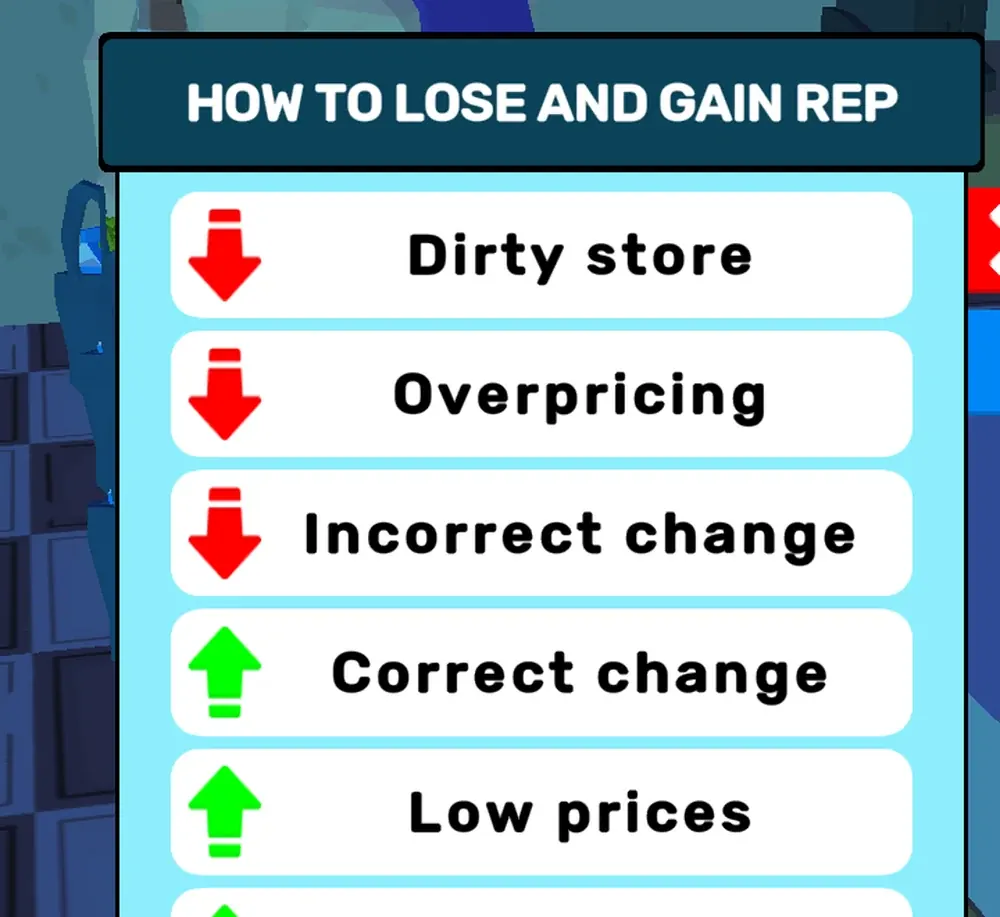
- IN-GAME the red objective card, the change panel and the six reputation lines
- OFFICIAL ONLY the store pages warn about none of this
- NEEDS CHECK how much reputation a single mistake costs, and whether it can be recovered
1. Carrying the box instead of binning it
The eighth tutorial objective does not advance until the empty carton is in the bin outside, and the card stays red on screen while you carry it around. The trick is that "outside" means the street, not the shop floor: walking to the door with the box and stopping is where ours nearly ended.
The fix is one sentence: every box ends the same way, lid open, goods on the shelf, carton in the bin.
2. Getting the change wrong
The till prints four numbers and lets you build the difference yourself:
RECEIVED — what the customer handed over
TOTAL — what the basket costs
CHANGE — RECEIVED − TOTAL
GIVEN — what you have put on the counter so far
AUTO is labelled as filling the drawer for you; we never pressed it. Doing it by hand is the only way we know to lose money
in this game, and the reputation card names Incorrect change as a penalty, so
the loss is not just the coins. We have not dared give the wrong amount on a real
save to see what the panel does.
3. Pricing too high
Overpricing is on the same list of reputation losses. We have not found the
screen that sets a price, so we cannot tell you what counts as too high — only
that the game considers it a mistake you are capable of making.
4. A long shift on empty shelves
This one is judgement, not measurement. Shifts run from 8 to 12 hours and the customers keep arriving either way. A twelve-hour day with one product on one shelf is twelve hours of watching people find nothing to buy. Until stock can keep up, the shorter shift is the safer trade.
5. Buying furniture before the licence wall matters
The order terminal has a Licenses tab and eight product cards that read
LICENSE NEEDED. Furniture, by contrast, is sold plainly — DRY SINGLE STORAGE
at $150, SELF CHECKOUT at $750. A player with $25 can buy neither, but a
player with a few hundred can spend it on a fixture while half the catalogue
stays locked.
6. Closing with customers still inside
At 20:00 the objective card turns red and states the rule:
You can't end the day without dealing all the customers inside the shop
Any plan that assumes the day ends on the clock is wrong. The queue is the last thing you clear, not the first thing you abandon.
What the game does not warn you about
Nothing in the portal description, the store page or the tutorial prompt mentions any of the six. The tutorial teaches the loop and the help cards name the reputation penalties; everything else is learned by doing it once and reading the card afterwards.
What we still cannot put a number on
How much reputation one mistake costs, whether the gauge recovers on its own,
whether a customer who leaves unserved is counted anywhere, and what Overpricing
compares your price against. Those are the four questions we would answer next
with a controlled session, and this page will be rewritten when we do.
Last checked against the client: 2026-11-04 · client web build 2026-11-04